Currently used IHT protocols lack standardisation, limiting safety and performance. Existing dose measures combine altitude with exposure time but ignore exercise-induced variation in individual oxygenation. We propose Effective Hypoxic Dose (EHD): a continuous-SpO₂ metric that is both relative to the individual and sensitive to the nature of the exposure.
01 – Headline Findings
Genetically identical participants, divergent training. EHD captures the difference where altitudextime methods cannot – revealing within-session variation that simpler averaging obscures.
CP Cumulative EHD
16,044EHDU
Intervention twin · 18 IHT sessions · 21.4 h hypoxia
GP Cumulative EHD
727EHDU
Control twin · 12 sessions
Per-session Differential
14.7x
Per-session hypoxic-dose ratio between participants
Per-session range
158–1,916EHDU
Within-participant session variability captured by EHD
* 1 EHDU = 1 %²·hrs (the time-integral of squared SpO₂ deficit below baseline).
02 – EHD vs AltitudexTime
Across the 18-session block, EHD and the conventional km·hrs metric diverge sharply. Sessions with identical altitudextime exposure produce up to 3x differences in EHD – driven by individual desaturation depth that altitude alone cannot see.
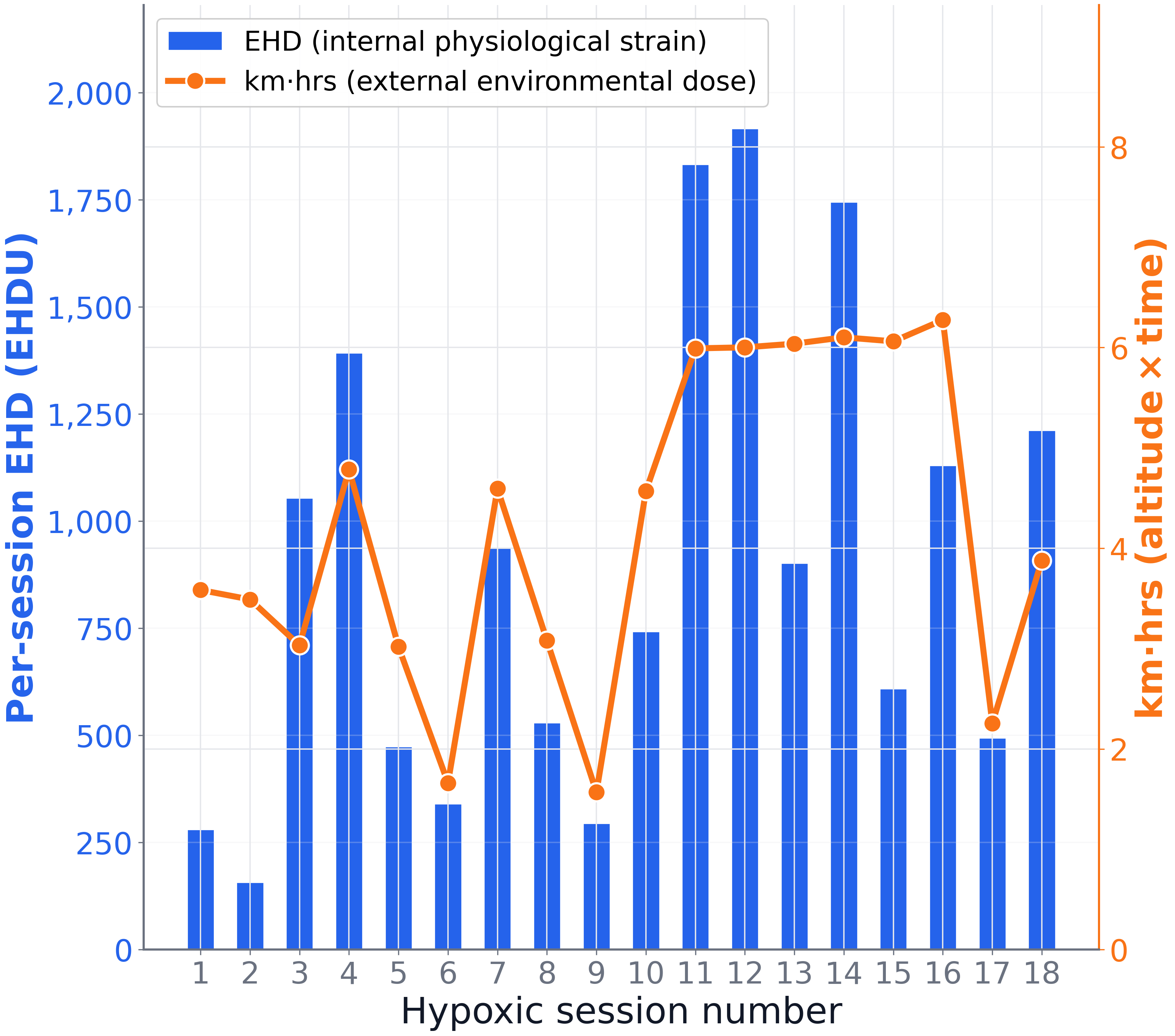
Per-session EHD (blue, internal hypoxic stimulus) vs km·hrs (orange, external environmental dose) across 18 IHT sessions. Where the two diverge, an altitudextime measure misses the physiological reality.
03 – Field Deployment
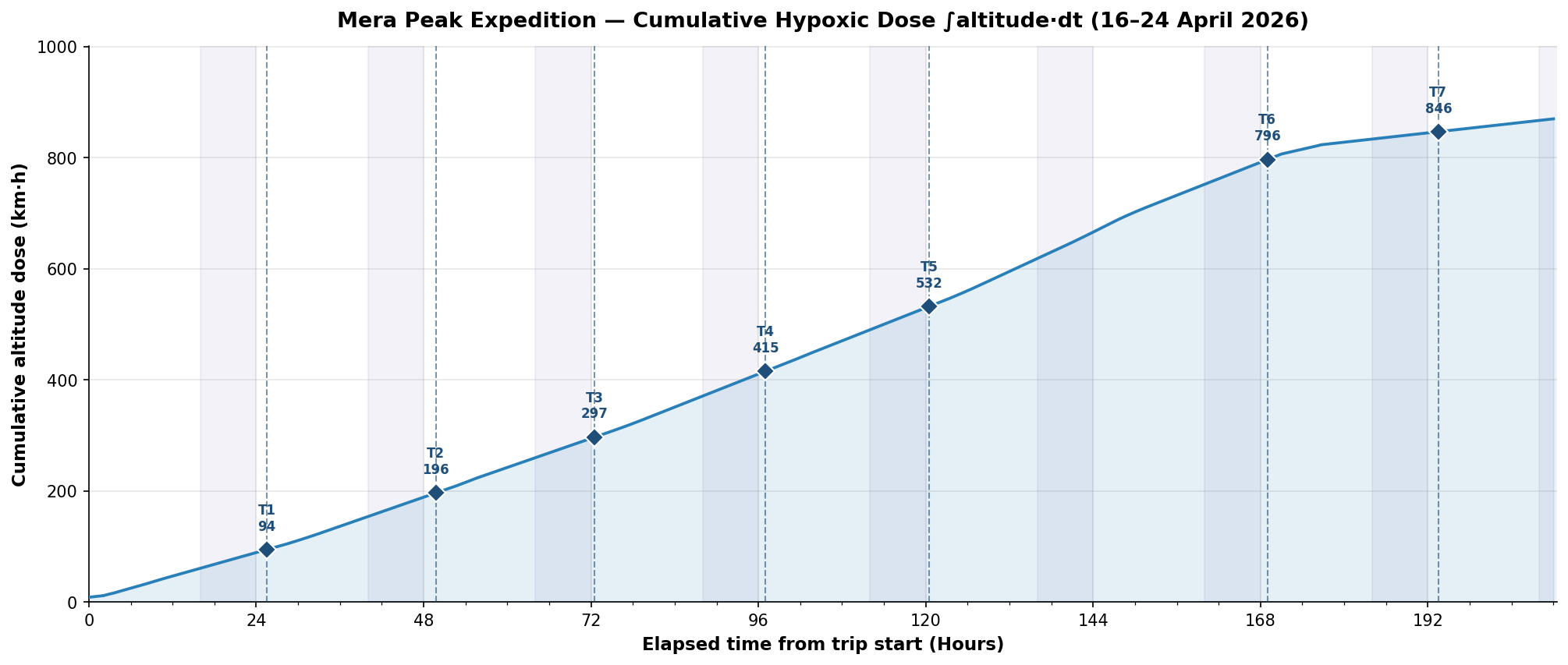
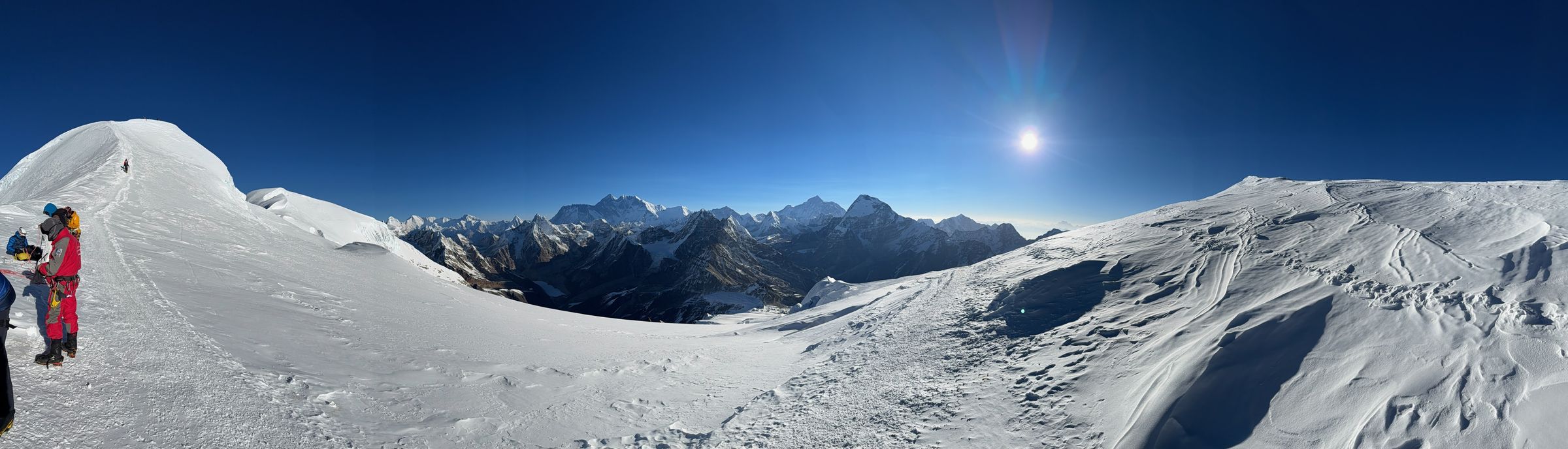
The same methodology was deployed in the field on a real expedition. From Kothe (3,600 m) through Mera Base Camp to the summit at 6,476 m, our platform captured continuous SpO₂ for the full ascent, with seven on-trail step tests anchoring the dose-response curve. Full EHD analysis of the Mera dataset is the subject of forthcoming work.
Reference profile in conventional altitude·time units (Mera Peak expedition, 16–24 April 2026) with on-trail step-test anchors T1–T7. EHD analysis of the same continuous-SpO₂ dataset is forthcoming – it will resolve within-individual variation that the curve above cannot.
04 – Method
EHD is calculated as the time-integral of the SpO₂ deficit below an individualised resting baseline, with weighting tuned to the disproportionate physiological impact of deeper desaturations. SpO₂ was acquired at 1 Hz via FDA-approved wearable oximetry (OxiWear) and transmitted via Bluetooth to a custom platform with automated artefact rejection. The same platform supports real-time feedback for FIO₂ adjustment in IHT, on-mountain monitoring, and post-expedition analysis. The full methodological paper is forthcoming in High Altitude Medicine & Biology.
05 – Related Publication
Passive Normobaric Hypoxic Exposure and High-Altitude Acclimatization in Monozygotic Twins on Mount Everest.
06 – Authors
07 – Get in Touch
We're actively engaged with research collaborators, mountain-medicine clinicians, and elite-sport groups exploring continuous-SpO₂ dose tracking. If our methodology might apply to your work, we'd like to hear from you.
No spam. We'll reach out personally. · Frontier Performance home →